
The Visibility Trap: Why Most Personal Brands Never Attract Customers Who Stick Around
And how can you start doing that...

I once left a comment on a copywriter’s LinkedIn post:
“...not all attention is worth having...”
The post was about how most personal brands can’t seem to turn LinkedIn into clients. The usual read in the comments was the obvious one: they’re not getting enough attention.
I think the real problem is the opposite.
We’ve been taught that attention is the finish line. Get seen, book the meeting, close the client, and you’ve made it. You can call your personal brand a success.
That’s half the picture. And it’s the dangerous half to be missing.
I’ve spent most of my career on the other half. Helping businesses keep the customers they already have and make more money from them. So when I watch someone pour everything into getting attention and winning new customers, it gives me chills. Because new customers don’t save a business that can’t keep them. They just hide the leak for a while.
And keeping customers doesn’t start after they buy. It starts with who you let in.
Here’s the part nobody connects. The audience you attract shows up already believing something. Your posts taught them what the work is. Your newsletter taught them what to expect. By the time they buy, the story is already running in their head, and your content is what wrote it. Attract the wrong audience and they buy expecting the wrong thing. Then they ask for a refund, go quiet, or never buy again. That’s a retention problem that started months before anyone became a customer.
So audience quality isn’t a vanity metric. The audience you build is the customer you’ll have to keep.
That’s what got me thinking for a week. And it led me to a hypothesis:
Personal branding might be one of the best retention tools a business has. Not for growing an audience. For shaping the kind of customer who stays and buys again. But nobody out there teaches it that way. Everybody teaches growth.
So I spent the month testing it. I went through 100 LinkedIn profiles, posts, and brand-building guides, and 100 Substack essays, guides, and growth playbooks. All of it from people teaching you how to build a stronger personal brand.
I asked one question: does this advice help you build an audience that becomes customers who stay, come back, and buy again?
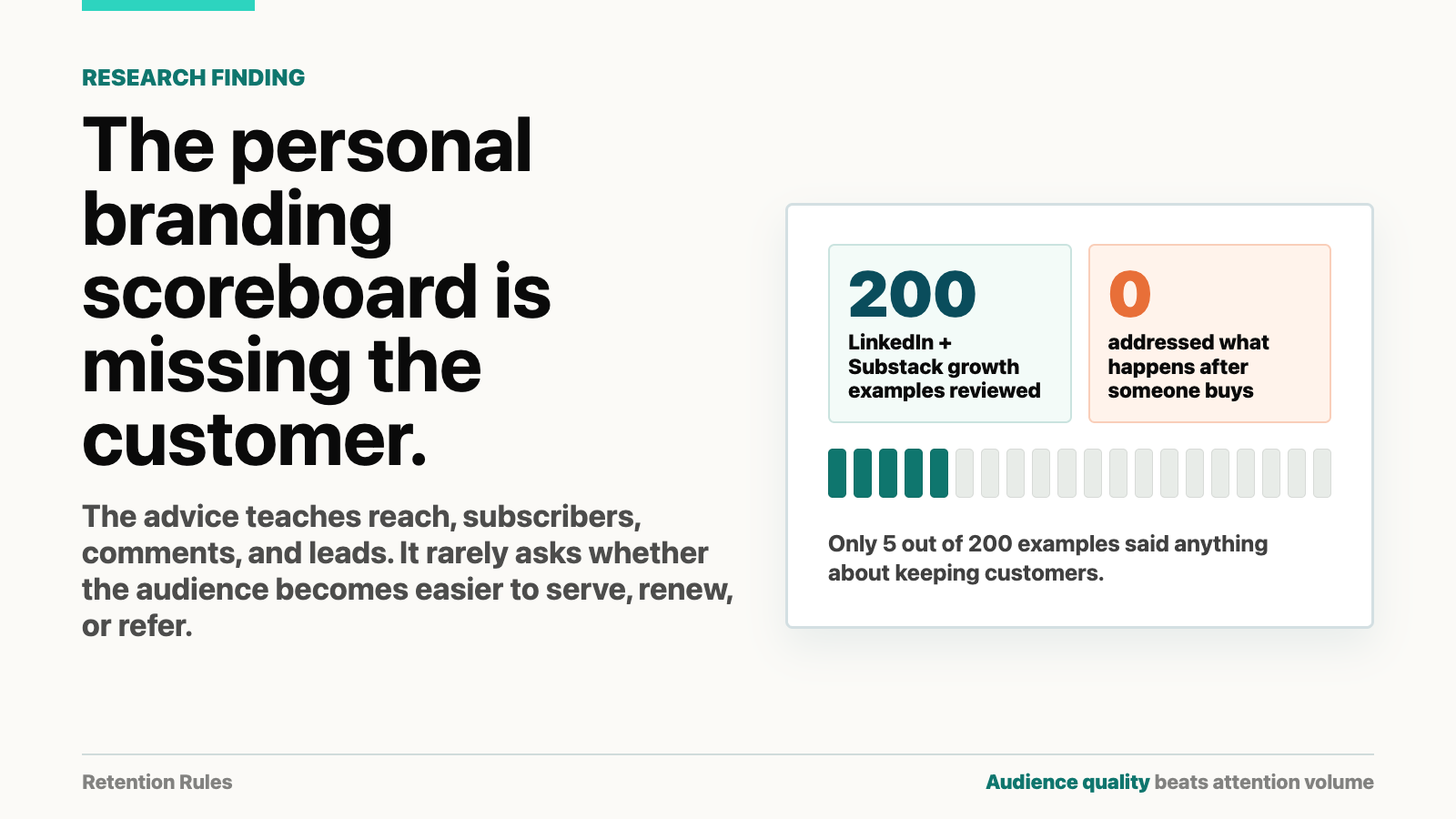
The answer was hard to sit with. Out of 200 data points, only 5 said anything about keeping customers. Zero said a word about what happens after someone buys. And a lot of the advice wasn’t just silent on retention. It was quietly training people to attract the kind of audience that’s harder to keep.
The timing makes it worse. AI made starting a business easy, and it made getting your first few customers easy too. The hard part now is keeping them and scaling, and that takes more thinking than it used to, not less. Personal branding advice hasn’t caught up. It’s still chasing followers, treating impressions like a scoreboard, and calling an AI-slop lead magnet a strategy.
The job of a personal brand has changed. It isn’t there to flood your business with attention. It’s there to bring in customers who arrive with the right expectations and stay long enough to be worth it.
So if you’re running a LinkedIn or Substack personal brand, and you want an audience that sticks around and keeps buying instead of one that just watches, this is for you.
Personal branding tactics can win attention while attracting the wrong customers
Most LinkedIn and Substack growth playbooks still treat attention as the win
I reviewed 200 pieces of public growth advice, 100 from LinkedIn and 100 from Substack. These were profiles, posts, guides, essays, and personal branding playbooks, the kind of material people publish when they show you how to build a personal brand.
On LinkedIn the advice was about profile optimization, posting consistency, hooks, comments, reach, and inbound leads, while on Substack it was around Notes, recommendations, free subscribers, launches, and turning readers into paid customers.
That advice is incomplete. You can use it to grow an audience and still damage the customer base you have to retain. The people selling it rarely ask whether the audience you build will become the kind of customer you can sell, serve, keep, renew, or turn into referrals.
Most people stop at the moment the audience becomes a buyer.
A personal branding guide can grow the wrong audience
A LinkedIn profile guide that stops at profile views is incomplete. A post-writing guide that never asks whether the post pulls in a better buyer is incomplete. A Substack essay that wins subscribers but creates weak-fit buyers is not a retention asset.
Those guides stop too early. They count the audience before the business has to serve it. The damage shows up later, when the people they bring in are harder to keep than they were to attract.
The usual personal branding scoreboard ignores customer quality
Out of 200 examples, only five asked the question that actually matters.
Does this bring in someone who will be easier to sell, easier to serve, more likely to renew, and more likely to send you the next customer? A few guides brushed against better-fit buyers, but most people still scored the work by attention, reach, subscribers, comments, and leads coming through the door.
That tells you what the whole market rewards. People know how to grow an audience, and they go quiet the moment you ask what kind of customer that audience turns into. In a retention system, you ask that question before you celebrate anything, because a big audience counts for very little when the people in it leave as soon as they buy.
Bad advice brings in buyers with the wrong expectations
That is why the trap is hard to spot. You can use the tactic, see more people coming in, and still end up with customers who are harder to keep.
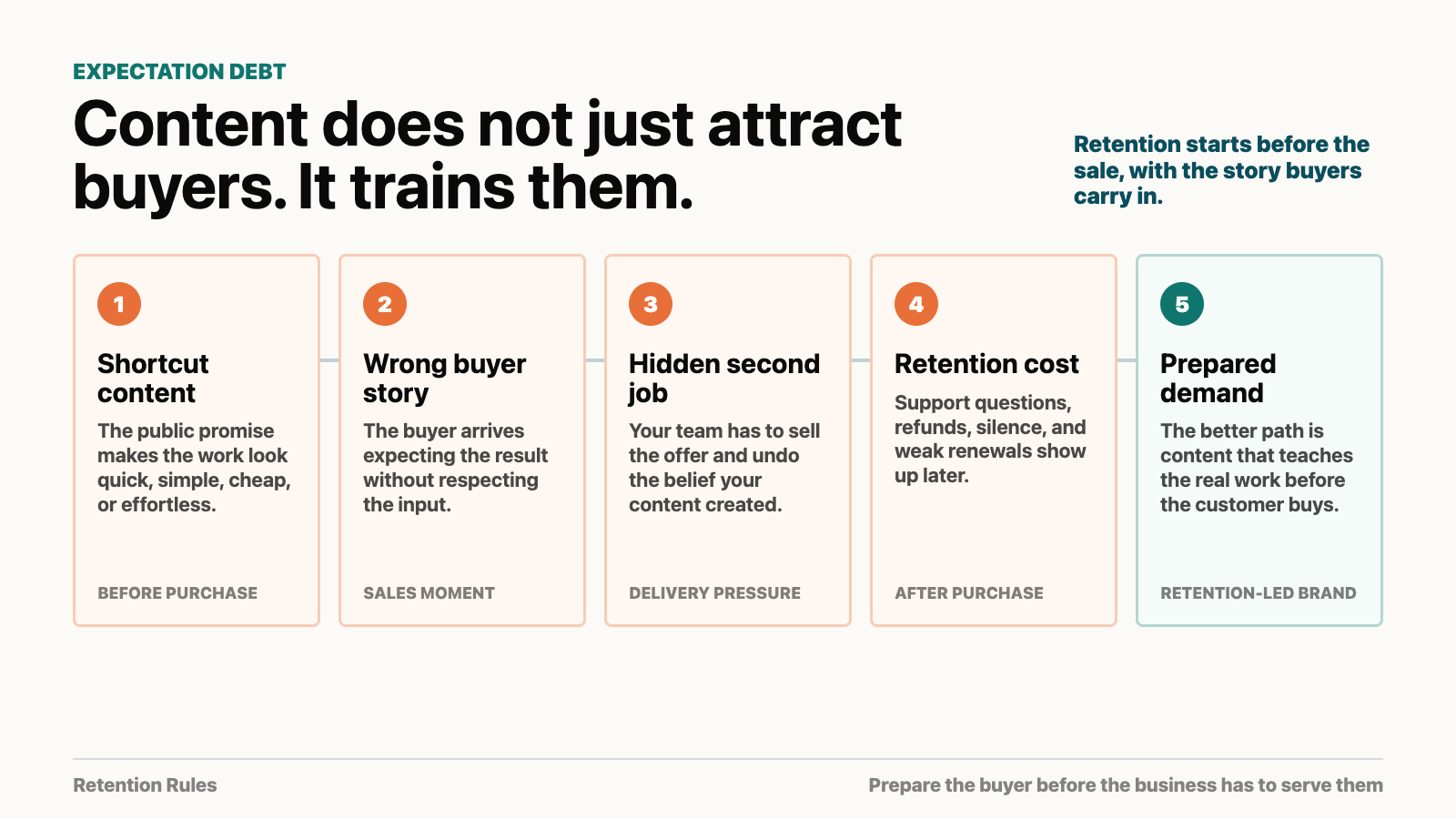
You use the same posts and essays that attract people to set expectations. By the time someone buys, they are not a blank slate. They walk in carrying a story about your offer, and often that story is wrong.
Customers show up with beliefs you gave them through content
Every buyer reaches your sales call, your checkout page, or your first project with a story already running in their head. They have decided what the problem is, what is causing it, how long the fix should take, how much effort it needs, and how much of that effort is theirs. You did not just attract that person. You shaped the story they brought into the sale through the content they saw before buying.
Make quick and simple the main story in your LinkedIn posts, and people show up wanting quick and simple. Turn every Substack essay into a tidy five-step checklist, and readers arrive expecting a checklist. Sell the result while hiding what it costs, and the buyer falls for the outcome and resents the work the second it asks anything of them.
Now your sales team has two jobs in one call. They have to sell the offer, and they have to undo the belief you spent months building through your content. That second job is expensive because it lands so late, after the person has already subscribed, booked, or paid, and after you have already marked the growth as a win. The damage stays buried until they ask you to deliver the version of the promise you never actually made.
Retention comes down to one thing. People stay when the business they bought turns out to be the business they were prepared for. Prepare them for a shortcut and they will resent you the moment the real work starts. Prepare them for the work and the first hard step feels like the deal they signed up for instead of a bait and switch.
The wrong audience looks good until your team has to serve it
A growing audience hides a lot of sins. More followers look useful until your calendar fills with calls from people who were never going to buy. More subscribers look useful until half the list loves your writing and has no interest in your offer. The number climbs either way, so it keeps feeling like progress.
A good-fit audience already understands the work and respects the standard. They can tell who the offer is built for and who it will annoy, and they do not flinch when the first step asks them to think, send something over, change a habit, or stay with a process.
A wrong-fit audience will still like your posts, share your essays, download your guide, and even buy. That is what makes them expensive. They ask beginner questions after following you for months. They want the result without doing the input. They compare your method to a nineteen-dollar template. They treat the first week after buying as a waiting room instead of the first win, then lean on you for reassurance about expectations you should have set long before they paid.
That carries a price. Support fills with questions the sale should have answered. Refunds climb. Renewals quietly stop showing up. Your team burns hours serving people you never wanted as customers.
No amount of extra reach fixes that. You recruited these people through your content, and you set their expectations on the way in.
Build a Retention-Focused Personal Brand around the whole customer path
A Retention-Focused Personal Brand is not a prettier content strategy.
It is the expectation system around the business.
It shapes who enters, what they believe they bought, what they do first, and why the relationship still makes sense after the first purchase.
That matters for SaaS, services, ecommerce, coaching, courses, local businesses, B2B, and anything else where the second purchase, renewal, referral, or repeat use matters. The product changes. The retention problem stays the same: the wrong people enter with the wrong expectation, hit the first friction point, and stop buying.
World building becomes useful here.
Not fantasy maps. Not lore for the sake of looking interesting. In personal branding, world building means the repeated beliefs, language, standards, proof, scenes, rituals, enemies, and customer examples people associate with you.
Most people use that to get attention.
A Retention-Focused Personal Brand uses it to create continuity.
The public brand and the customer experience should feel like the same place. The buyer should not trust you in public, pay you in private, and then feel like they entered a different business.
The visual version is simple:
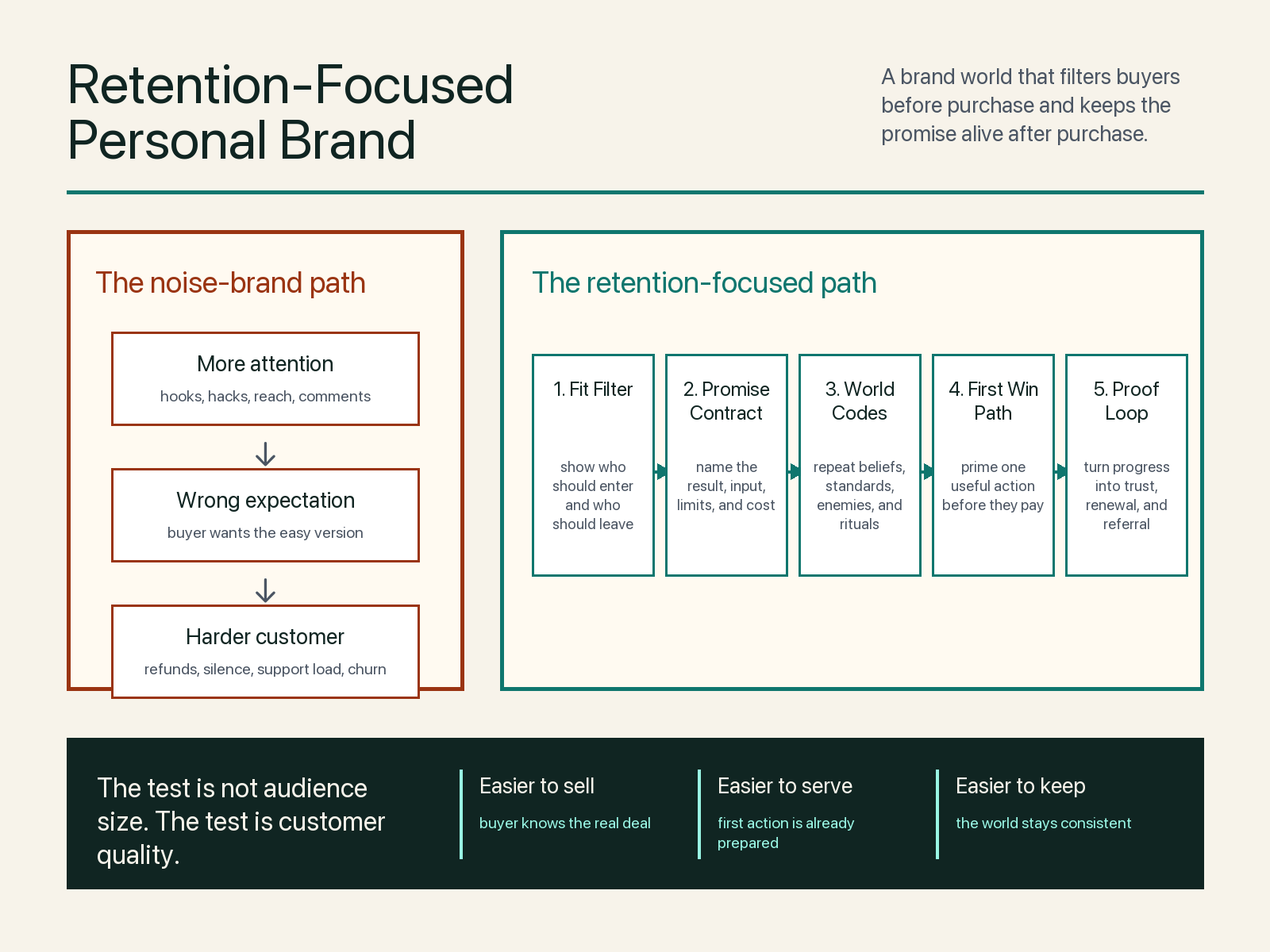
The Retention-Focused Personal Brand has five parts
These five parts are the difference between a personal brand that attracts attention and a personal brand that creates customers worth keeping.
1. Fit Filter
Decide who should enter before you optimize reach.
The usual personal brand tries to bring in as many interested people as possible. This version filters for people who can actually become good customers.
Before purchase, use your profile, posts, essays, lead magnets, ads, and interviews to show who the work is for, who it will annoy, and what kind of buyer will waste their money.
That means publishing content like:
Not-for-you posts that name the wrong buyer honestly.
Maturity posts that show what stage someone needs to be in before the offer makes sense.
Source-quality posts that explain why some leads are expensive even when they convert.
Standard posts that show the level of input, judgment, or effort the business expects.
For a service business, this can be a post showing the client input that makes a project work.
For SaaS, it can be a use-case post that says who the product is built for and who should not sign up yet.
For ecommerce, it can be fit, care, sizing, replenishment, or use-case content that stops the wrong buyer before checkout.
After purchase, track the source. Ask buyers what made them believe this was for them. Compare that answer with refunds, support load, repeat purchase, renewal, and referral. If one content angle brings attention but creates difficult customers, stop calling it a win.
2. Promise Contract
Name the real deal before money changes hands.
The usual personal brand sells the outcome. This version sells the outcome with the input attached.
The promise should say:
What result the buyer can expect.
What creates that result.
What the buyer has to do.
What the offer will not do.
What poor fit looks like.
This can show up as trade-off posts, objection posts, “what this actually takes” essays, pricing context, sales-page sections, launch emails, case studies, product pages, and founder posts.
The point is not to make the offer sound harder. The point is to stop the buyer from inventing the easy version in their head.
After purchase, repeat the contract immediately. The welcome email should confirm what they bought, what happens first, what friction is normal, what progress will look like, and what they need to do next.
This is where a lot of businesses create churn without seeing it. Public content sells one version. Customer onboarding delivers another. The customer does not call that nuance. They call it disappointment.
3. World Codes
Build the buyer’s operating world.
This is the world-building piece.
A brand world is not a vibe. It is the repeated signals that show people how your business works, what it values, and what it refuses.
You need five codes:
The enemy idea: the weak belief you keep attacking.
The standard: the line your business refuses to go below.
The language: the phrases your best customers start using because they understand the work.
The ritual: the repeated action that makes your method visible.
The proof character: the kind of customer story that shows who wins in your world.
That is what separates this from generic personal branding. The usual brand story makes the founder look interesting. A retention story makes the future customer more accurate.
Use standard-setting stories. Show the moment you refused weak work, rejected a shortcut, changed your mind, fixed a bad assumption, or watched a customer win because they respected the process.
Use mistake-cost stories. Show what broke when someone chased the easy version.
Use customer-progress stories. Show the messy middle, not just the screenshot at the end.
Use belief-change stories. Show how a customer stopped judging the work like a cheap tactic and started seeing the real problem.
Those stories build trust differently from lead-attraction stories. Lead-attraction stories make people notice you. Retention stories make the right buyer trust the way you think when the work becomes less exciting.
4. First Win Path
Prime one useful action before the buyer pays.
The usual personal brand gets the nod. This version prepares movement.
The buyer should already know the first useful action before they become a customer.
For a service business, that first action might be sending customer objections, cancellation reasons, sales call notes, last ten emails, creative examples, product usage data, or support tickets.
For SaaS, it might be choosing one use case, importing the first dataset, inviting the right teammate, completing the first workflow, or reaching the first output they would actually use.
For ecommerce, it might be measuring correctly, choosing the right variant, using the product the right way, caring for it, reordering at the right time, or pairing it with the next logical product.
For coaching or courses, it might be a belief reset, a diagnostic, a small implementation step, or a proof-of-work assignment before the next lesson.
Your free resource should do a small version of the real work. A scorecard, audit, calculator, teardown, checklist, setup map, buying guide, or diagnostic works when it makes the buyer face the real problem and take one action.
After purchase, do not dump them into a portal, dashboard, inbox, or welcome sequence with no movement.
Give them one first win. The first 24 hours should answer one question:
What can this customer do now that proves they made the right decision?
5. Proof Loop
Turn customer progress into the next layer of trust.
The usual personal brand uses proof to close the sale.
This version uses proof before and after purchase.
Before purchase, proof shows what kind of buyer wins, what changed, what input mattered, what friction showed up, and what result became possible.
After purchase, proof keeps the customer oriented. It reminds them why the method works, what progress looks like, and why the hard part is not a sign that the promise failed.
Use surveys for this.
Not generic “how was your experience?” surveys.
Use sharper questions:
What did you think this would be before buying?
What surprised you after starting?
Where did you get stuck?
What almost made you stop?
What first result made you feel this was working?
What would you tell someone who is about to buy?
What would make this worth renewing, reordering, upgrading, or referring?
Then turn the answers into content and lifecycle material.
A support question can become a public objection post.
A cancellation reason can become a promise fix.
An onboarding friction point can become a first-week email.
A repeat-purchase reason can become ecommerce product education.
A feature-adoption pattern can become SaaS use-case content.
A client milestone can become service-business proof.
A customer phrase can become the language of the brand world.
This is how the brand gets sharper after customers buy. Not by posting more. By feeding customer reality back into the public world and the private customer experience.
What changes before purchase
The profile stops being a bio and becomes a filter.
It should tell the right buyer what problem you solve, what standard you bring, who the work is for, and who should leave.
Content stops being a pile of tips.
Use diagnostic posts, trade-off posts, standard posts, proof-with-mechanism posts, belief-change stories, first-action posts, and disqualification posts.
The free resource stops being bait.
Use it as a work sample. Make the buyer inspect their own situation, make one decision, or complete one small action that resembles the real work.
Distribution stops being a reach game.
Choose rooms where better-fit buyers already gather. Serious operators, existing customers, decision-makers, category-aware buyers, niche communities, or people already close to the pain will create better customer quality than casual reach.
Stories stop being founder theater.
Use stories that build trust in the method: the mistake that changed your standard, the customer who won because they did the hard input, the project that failed because expectations were wrong, the moment you rejected the shortcut, the objection that revealed the real problem.
What changes after purchase
The welcome email repeats the real deal.
It should confirm the promise, the first step, the normal friction, the timeline, and what the customer needs to do next.
Onboarding creates movement.
The first step should match the world you built in public. If your public content is diagnostic, onboarding starts with diagnosis. If your public content is standards-led, onboarding starts with a standard. If your public content talks about customer behavior, onboarding asks for customer behavior data.
Email keeps the world coherent.
Use post-purchase emails to reinforce the promise, explain normal friction, show progress markers, answer common doubts, share customer examples, and move the customer toward the next useful action.
Surveys catch the gaps early.
Run an expectation survey right after purchase, a first-value survey after the first meaningful action, a friction survey when usage drops, and a renewal or reorder survey before the next buying moment.
Proof keeps the customer bought in.
Show proof after the sale too. Send examples of customers using the product, completing the process, solving the same friction, reordering at the right time, renewing for the right reason, or getting more value from the next step.
Renewal and referral come after value.
Do not ask for a referral because the customer likes you. Ask when they have a specific result, milestone, saved problem, repeated use, or second purchase they can point to.
Use this audit to rebuild your brand around retention
Pull up your profile, last ten posts, last five essays or emails, main free resource, welcome sequence, onboarding emails, post-purchase emails, customer surveys, and proof assets.
Ask five questions:
Fit Filter: who does this let in, and who does it push away?
Promise Contract: what expectation does this create about the result, input, timeline, and limits?
World Codes: what belief, standard, phrase, enemy, ritual, or proof character does this repeat?
First Win Path: what useful action does this prepare the buyer to take?
Proof Loop: what customer reality does this capture and feed back into the brand?
That is the audit.
If an asset attracts attention but does not improve fit, expectation, trust, first action, or after-purchase reinforcement, it is not doing retention work.
Growth advice measures audience size. Retention measures customer quality
In growth-first branding, you ask whether more people saw the work.
In retention-focused branding, you ask whether the right people became more prepared to buy, use, stay, renew, reorder, and refer.
That is how you judge the machine.
Personal branding is not new. The internet industrialized it.
Now operators have to decide what the machine is for. You can use it to feed weak-fit demand into the business, or you can use it to build a buyer’s world before purchase and keep that world alive after purchase.
Customers rarely misunderstand the offer on their own.
You either gave them the wrong expectation through your content, or you helped them arrive ready.
This was such a refreshing read, man!
So little is talked about retention because few founders realise that there’s more than just audience building that could make them more money without necessarily overextending themselves.
I’m willing to bet, soon CLV is going to be even more important to focus on.
The experience of those in our paid programs who have paid, and therefore, are more likely to pay, and keep investing in themselves is such a low hanging fruit.
Incredible value.