
Competitor Hacking: Why copying competitors makes customer retention harder
Why customer alienation happens before churn, and how to use the 10/20/30 Research Principle to fix it

Back in 2016, during our medical college days, a cook ran a small hotel across the street from the residential building our college had been temporarily given by the government.
When his regulars started eating elsewhere, he spent his afternoons spying on other hotels nearby. He would pop up at one of the hotels during rush hours, make friendly conversation with the staff, and leave. But what he actually did was copy their menus, dishes, and he even repainted his signboard to look more like the busiest hotel in the area. I know this because he used to brag about it to show us how smart of a businessman he was. We were fans of his ‘marketing wit’.
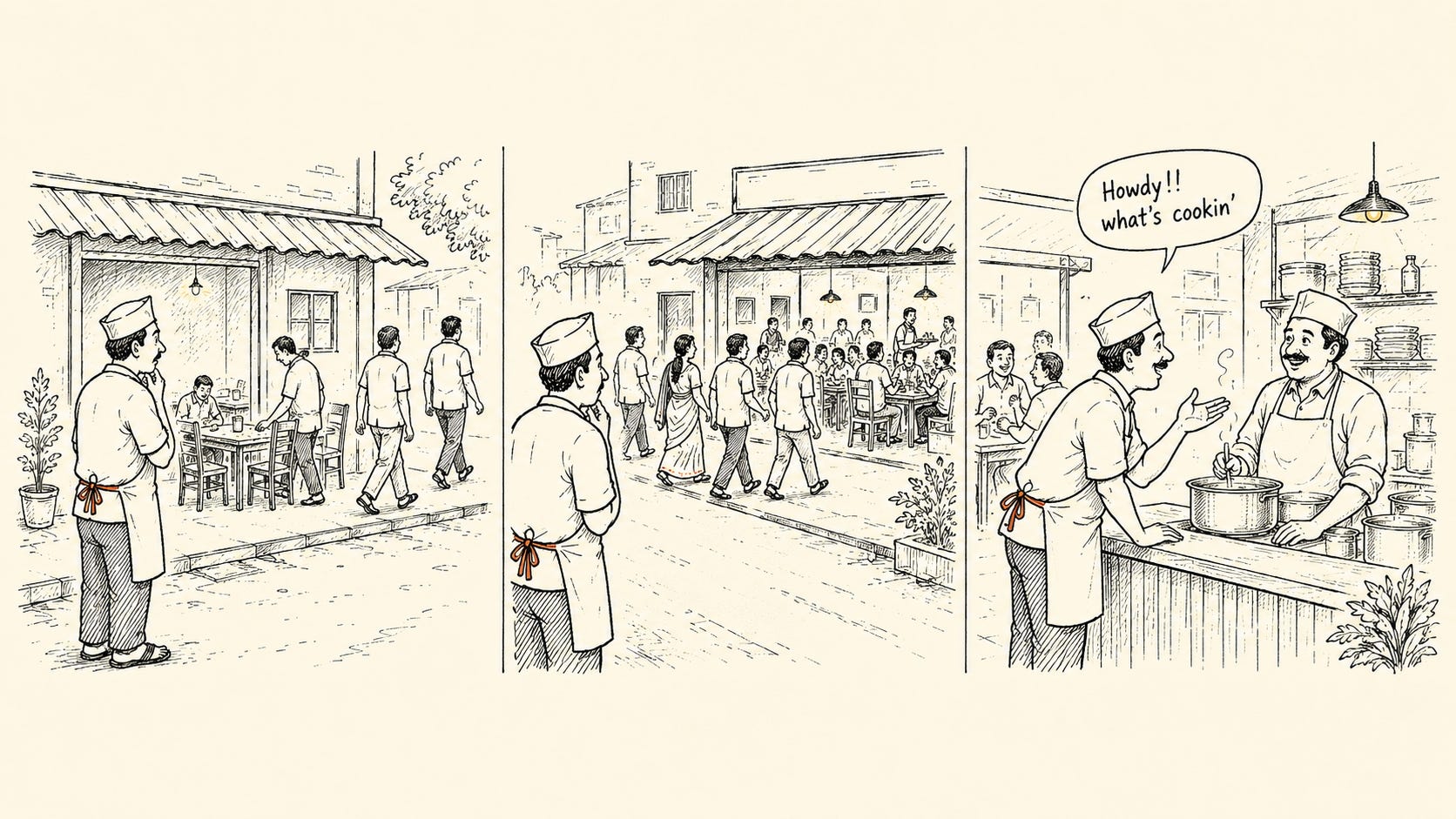
But his customers kept leaving.
And he kept making the same mistake of copying his competitors until he had to shut down his shop.
What the cook never did was ask the students why they had stopped coming or ask the rest of his customers what had changed.
We could have told him everything he needed to know to save his business because we were in on the gossip. And the gossip was this:
The students (his main customer base) wanted warm daal that tasted like home. They wanted chai brewed strong and less sweet. They wanted rice that did not feel rushed. They wanted the cook to know their name when they walked in after class. All of which he abandoned as his business boomed.
You see, you can’t get any of that information from competitor hacking. Only your customer can answer what they expect from you.
Ten years later, after spending more than three years in marketing, I see founders and marketing teams making the same mistake. Customer retention is harder than ever, and they keep looking across the street. According to Forrester, US customer experience quality fell for three straight years and hit an all-time low in 2024. The data shows customers are less loyal, less patient, and less emotionally connected to brands today than they were just a few years ago.
Businesses notice the damage late, then blame the visible symptoms: deliverability, open rates, discounts, AI noise, ad costs, platform changes, or customer fatigue. So they reach for faster marketing work. More swipe files. More competitor teardown calls. More “what are other brands doing?” research.
That response can deepen the original wound. The copying spreads into positioning, product features, landing pages, offers, and email flows. Then marketers wonder why customers feel less attached to the brand every quarter.
The time a business spends hacking its competitors could be better used to understand ideal buyers. Competitor Hacking slowly eats away at your customers’ trust from the inside. Customers do not always get angry. Anger would be easier to see. They just stop responding to your marketing.
That distance is customer alienation.
The retention costs the dashboards show come way later than customer alienation. The first casualty is that a customer no longer feels like the brand knows her, remembers her, or has anything of its own to say.
I learned this lesson the hard way because early on I used to spend too much time looking at our competitors. I am also guilty of creating entire campaign briefs out of screenshots and calling market research. The brands I was working with slowly started to sound like everyone else in that space.
Competitor research has its value. A serious business should know about other big players in its category. But when customers are leaving, the first place to look is not your rival’s campaign, your rival’s pricing page, your rival’s new feature, or your rival’s funnel. The first place to look is your own customer. Because only the customer can tell you what made them trust you in the first place and what broke it.
This is for anyone whose KPI includes a retention number. That might be repeat purchase at a DTC brand, monthly churn at a SaaS company, list health at an info-product business, or LTV across a subscription program. If your job is to keep customers, this is for you.
TL;DR
Customer retention is getting harder. Businesses are noticing the damage late, then blaming the visible symptoms: deliverability, open rates, discounts, AI noise, ad costs.
The real problem is deeper. Customers are distancing themselves from brands before they actually leave. They stop remembering. They create distance. They trust less. By the time the dashboard shows churn, the relationship has been weakening for months.
When that happens, businesses reach for the wrong fix: more competitor research. They copy positioning, products, offers, landing pages, and email flows from rivals. That habit, what I call Competitor Hacking, has become so widespread that it now functions as a business culture, not a tactical mistake.
This article does three things:
Shows how customer relationships weaken in three stages before churn, and how Competitor Hacking accelerates each one.
Proves that Competitor Hacking is a culture, not a habit, by walking through the six attributes that define it.
Introduces the 10/20/30 Research Principle, a framework that operates at three levels (Philosophy, Process, Practice) and caps competitor research at 30 percent of total research time at any business stage. Customer research takes the rest.
The framework comes from three years of practitioner work. The results, including more than doubling revenue per lead and recovering $1.1M from an audience the business had written off, came when customer understanding led the work and competitor research only checked the edges.
If you keep customers for a living, this article gives you a working system to replace Competitor Hacking with customer-led marketing. The fix is not less competitor research. It is the right amount, in the right place, never in the lead.
Customers distance themselves from brands way before they churn
Customers do not just wake up and decide to leave you one day. It happens in stages before you can even realize it. And you can observe it happening now more clearly than ever before.
Let’s discuss how it happens, what it means for your business, and how competitor hacking only adds fuel to this fire.
New research shows customer relationships are weaker
Forrester reported in June 2024 that US customer experience quality hit the lowest point in the history of its CX Index. The share of brands declining in customer experience quality more than doubled in a single year, from 17 percent to 39 percent.
KPMG reported in January 2024 that its US Customer Experience Excellence score fell to its lowest level since 2015. Grocery retail, financial services, and non-grocery retail all moved in the same direction.
Shopify’s 2026 commerce trends report cites SAP Emarsys data showing true loyalty fell from 34 percent to 29 percent in a single year. Fewer customers are sticking with brands because they feel connected to them.
ChartMogul’s 2024 SaaS retention report studied more than 2,500 SaaS businesses and found that hitting 100 percent or higher net revenue retention has become harder across every revenue segment. Net revenue retention above 100 percent means customers are not just staying, they are spending more over time. That bar is getting harder to clear.
The data does not say every business in every category is losing customers in the same way. It says the ground underneath retention has become weaker. Customers are less loyal, less emotionally connected, and less satisfied with the brands they buy from than they were a few years ago.
That makes every retention job harder.
When customers become harder to keep, the business needs to move closer to them. It needs to understand why people are leaving, why they are waiting, why they stopped replying, why they do not trust the offer, why they bought once and disappeared, why the first week after purchase failed, and why the product no longer feels worth mentioning.
Competitor Hacking feels rewarding because it is fast and gives marketers something concrete to point at. But faster information is not always better information, especially when the problem is happening inside your own customer relationship.
The 3 pre-churn stages of a weakened customer relationship
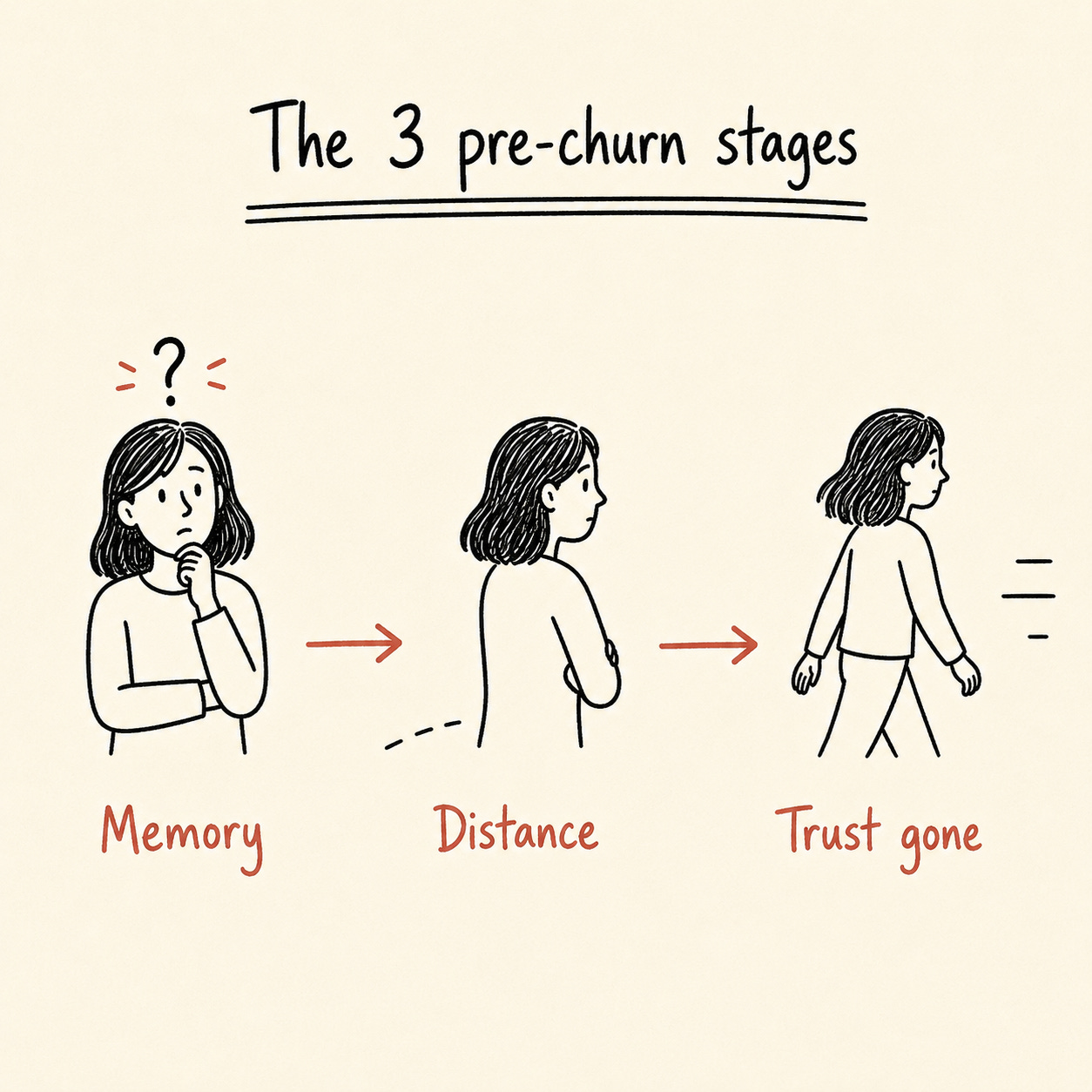
I went through research, case studies, past projects, customer notes, and conversations with retention marketers, and kept coming back to one conclusion:
Customers start losing the brand way before the brand loses them.
Dashboard churn shows up late. By the time the loss is clearly measurable, the damage has been building for weeks or months.
The customer may still be opening, browsing, waiting for a sale, or keeping the account active. But the relationship has already started to weaken.
Here are the three stages that decline usually moves through before the customer leaves.
Stage 1: Customers stop remembering what makes your brand different
The first loss is usually memory, not the purchase.
Customers remember brands that give them something specific to hold onto. That can be a sentence that names their problem better than they could. It can be a first-use guide that arrives when they feel stuck. It can be a support reply that makes them feel like a real person read their message.
Byron Sharp describes mental availability as the chance that a buyer will notice, recognize, or think of a brand in a buying situation. In plain language, a brand has to be easy to bring back to mind when the customer needs it.
That memory does not come from copying a competitor’s surface.
When positioning, offer, content, follow-up, and product experience all come from the same category pool, the brand becomes harder to place. The customer may still recognize the logo, but she has fewer reasons to remember why the brand mattered.
Stage 2: Customers create distance before they leave
After memory weakens, the customer does not always leave right away.
She may still open sometimes. She may still browse. She may still wait for a sale. She may still follow the brand. So the business thinks the relationship is still alive.
But she has already moved back.
She replies less. She clicks less. She visits less. She stops mentioning the brand when someone asks for a recommendation. True loyalty dropped from 34 percent in 2024 to 29 percent in 2025, which is exactly this pattern showing up in the data.
The customer starts creating distance before the dashboard shows churn.
Stage 3: Customers trust the brand less before churn starts
Customers give brands second chances when the relationship still has trust.
They forgive a late email. They forgive an average offer. They forgive a confusing onboarding step. They forgive a support delay if the larger relationship still feels worth keeping.
But when trust weakens, those second chances shrink.
The customer compares faster. She waits for discounts. She ignores the next launch. She reads the next message with less patience because the last few messages already felt replaceable.
Edelman has repeatedly tied trust to buying, loyalty, advocacy, and a brand’s ability to recover from mistakes. That matters because retention is full of small mistakes. A weak relationship gives the business less room to recover from them.
By the time churn starts showing up clearly, the customer relationship has been weaker for a while.
5 ways the damage shows up before churn starts
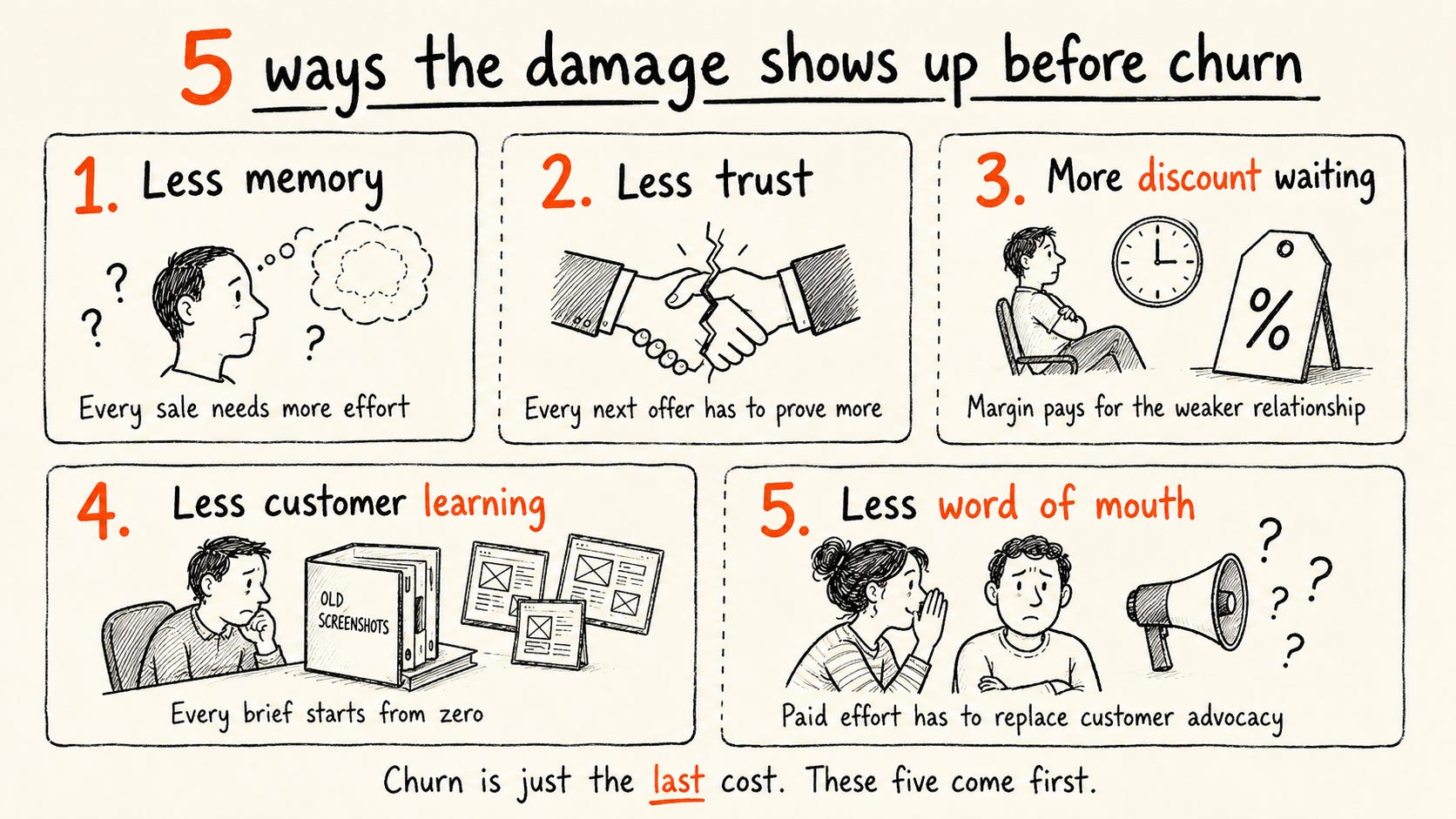
Churn is not the first cost. It is just the cost businesses measure most clearly.
Before churn starts, the business usually pays in smaller ways first. Customers become harder to reach, harder to convince, and harder to bring back.
Customers remember you less, so every sale needs more effort
When customers remember the brand less, the business has to remind them more.
A strong brand gives the customer something clear to come back to. She remembers the product. She remembers why she bought it. She remembers the moment the brand made her feel understood.
Competitor Hacking weakens that memory because copied work rarely gives the customer a clear reason to remember a brand. The emails may still go out. The landing page may look cleaner. The offer may look more polished. But if it sounds like every other brand in the category, the customer has less to hold onto.
That means more reminders, more retargeting, more launches, more follow-ups, and more effort to bring back a customer who should have remembered why she cared.
Customers trust you less, so every next offer has to prove more
Trust drops when customers feel the business is guessing.
They can feel the difference between a message built from their world and a message built from competitor screenshots. One names the problem in a way they recognize. The other sounds correct, but not personal.
A first purchase can happen because the offer is strong. A second purchase needs more trust. A renewal needs more trust. An upsell needs more trust. A customer who had one bad experience needs even more trust before she gives the brand another chance.
Customers wait for discounts, so margin pays for the weaker relationship
Discount dependence often looks like a pricing problem.
Sometimes it is. A price can be wrong. An offer can be weak. A category can train buyers to wait.
But when customers only respond to bigger discounts, marketers should ask a different question: what reason have we given them to care without the discount?
Competitor Hacking can make this worse because discount ideas are easy to copy. One competitor runs 20 percent off. Another runs 30 percent off. Another adds a bonus. Another extends the sale. Soon the customer learns the pattern.
Wait long enough and the business will beg louder.
Marketers learn less from customers, so every brief starts from zero
Customer understanding teaches the business something it can use again.
A sales-call theme can improve the landing page, onboarding, emails, product, and offer. A support-ticket pattern can show what the product needs next. A churn reason can improve the first week after purchase. A review phrase can become a better promise.
Competitor-led work does not compound the same way. Marketers may learn what a rival did. They may learn what the category is repeating. They may learn how not to look behind. But they do not learn much about their own customers.
So marketers keep needing more material. Another competitor scraped. Another teardown. Another screenshot deck. Another “what are they doing?” call.
Customer understanding builds memory inside the business. Competitor Hacking builds a folder.
Fewer customers talk about you, so paid effort has to replace word of mouth
Word of mouth weakens before referrals fall.
No dashboard tells the business, “Customers no longer have a clear reason to mention us.” Marketers just start needing more paid traffic, more launches, more reminders, and more discounts.
A recommendation needs a clear reason. The customer needs a sentence she can say to someone else. That sentence usually comes from a moment she remembers.
The product solved something cleanly. The brand named a problem perfectly. The support person made the issue painless. The onboarding helped her get a result faster than expected.
Copied work gives customers fewer of those moments.
The brand becomes harder to talk about because it becomes harder to remember clearly.
Businesses respond to customer alienation by fixing the late-stage symptoms
When retention gets harder, the first instinct is to blame the most visible symptom.
That makes sense. Visible problems show up in dashboards. Dashboards make them feel easier to spot, easier to talk about, and easier to fix.
The harder problem is the one that does not show up on any dashboard. It just shows up in the form of customers slowly leaving for other brands.
Dashboards make late-stage symptoms look like root causes
Here are the symptoms most businesses blame when retention gets weaker:
Fix deliverability because open rates dropped.
Change the email strategy because Apple Mail Privacy Protection made open-rate data messy.
Run a bigger discount because customers stopped buying at full price.
Blame AI noise because every inbox and feed feels more crowded.
Study competitors harder because marketers want faster answers.
These are real issues. They need to be addressed. But treating them as the main cause creates two problems.
First, they are late-stage symptoms. They can tell the business that something is wrong, but they cannot explain why the customer stopped caring.
Second, they pull attention away from the customer. The business starts fixing what is easiest to measure while the real relationship problem keeps growing underneath.
These fixes are real, but they only solve part of the problem
Deliverability is real. Emails can land in spam. Domains can get damaged. Sender reputation can fall. Bad list hygiene can hurt results. A retention marketer should care about all of that.
But deliverability tells the business its message may not be reaching the inbox. It does not tell the business why the customer stopped caring when the message did reach her.
Apple Mail Privacy Protection is real too. It launched with iOS 15 in September 2021 and made open-rate data less reliable because Apple can pre-load email images through a proxy. Klaviyo and most major email platforms now warn marketers to treat open rates with caution after this change.
That is a real measurement problem. It is not a full customer problem. Mail Privacy Protection can distort an open rate. It cannot explain why buyers no longer have a clear reason to remember the brand.
Discounts can create a short-term lift. A sale can pull revenue forward. A bigger offer can wake up a quiet list. A countdown timer can make the week look successful.
But sometimes the brand has trained customers to wait, or the offer has stopped giving them a strong enough reason to return.
A founder in r/ecommerce described a version of this problem. They had a decent email list, strong word of mouth, 5-star reviews, and customers who often reordered after the first purchase. But when they sent a discounted new-product email, it still completely bombed.
That is not statistical proof. It is the operator version of the problem: customers can like the product and still ignore the next offer.
AI noise and platform changes are also real. Ad costs move. Search changes. Feeds change. Buyers get tired. Markets get louder.
But these explanations are convenient. They let the business say the problem is outside the business. The platform changed. The buyer changed. The market changed. The inbox changed.
Maybe all of that is true.
It still does not explain why customer replies sit unread while marketers build another swipe deck.
When obvious fixes fail, businesses just copy what others are doing
When the obvious fixes do not work, businesses look for more material.
Competitor research feels useful because it gives marketers something clean to work with. A page to screenshot. An email to paste into a brief. An offer to compare. A campaign to discuss.
Customer understanding takes longer.
Customer replies are messier. Interviews are a hassle. Support tickets contradict each other. Getting enough useful answers can be slow.
But if the problem is the business and customer relationship, competitor hacking can only take you so far. A better relationship with a customer comes from spending less time on hacks and more time understanding the customer.
Got it. That opening is way stronger because it reframes the problem from the reader’s actual reality (most teams glorify it, they don’t recognize it as a problem). Let me rewrite the section opener and keep the H3 structure underneath.
Competitor Hacking isn’t just another marketing problem, it’s a business culture
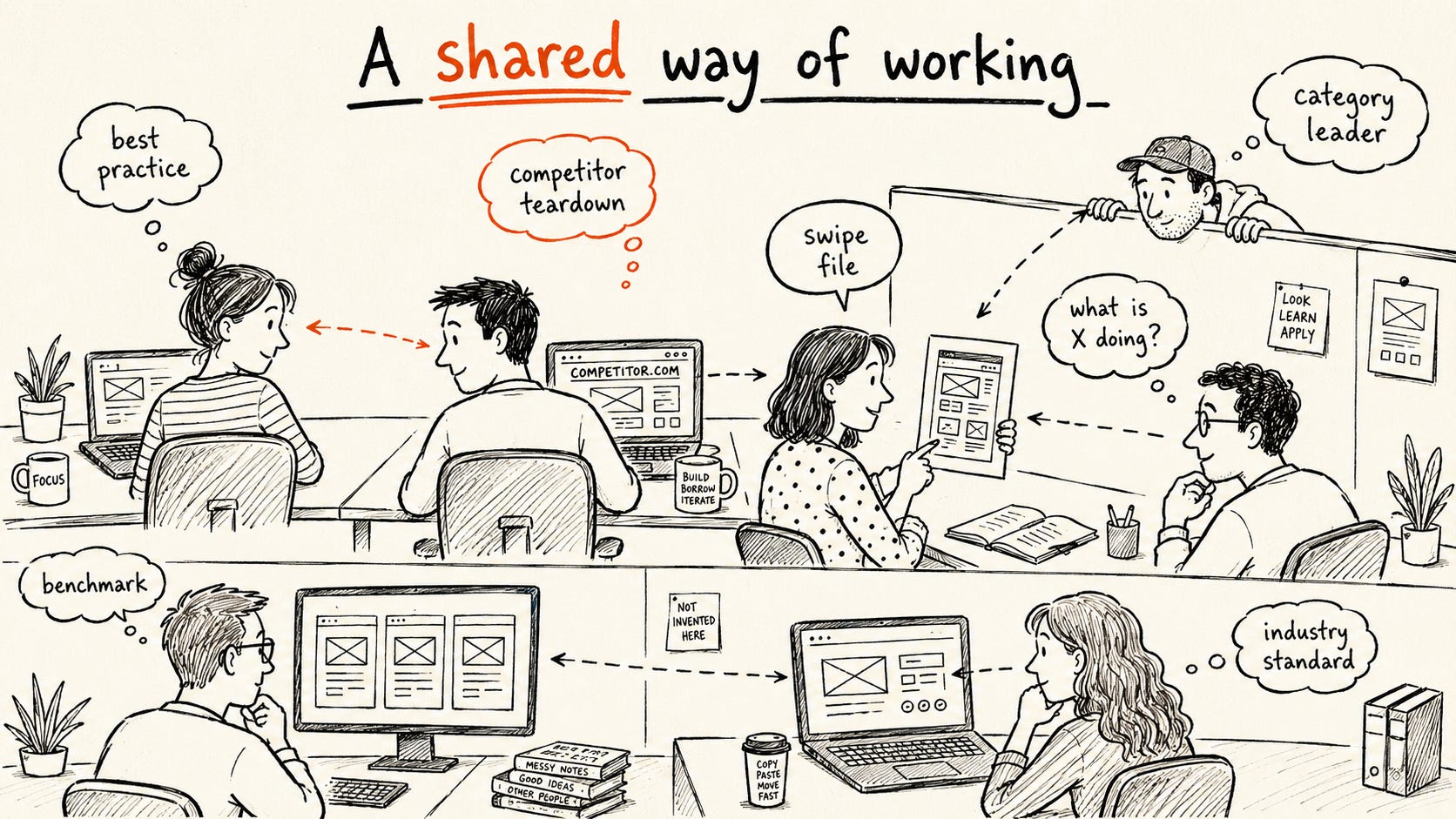
Competitor Hacking has its place. But it has been overly glorified.
It is a problem in most cases. Actually, I would not even call it a problem. That is too small of a canvas for what it is. An entire business culture has been built around it, posing it as smart, time-saving, and the responsible thing to do before any campaign, launch, or product decision.
I do not use the word culture lightly. Competitor Hacking and the views around it have all the attributes of a culture.
Competitor Hacking is shared across roles, not held by one team
A culture is something that lives across people, not inside one person. It survives when individuals leave because the next person walks into the same patterns.
Competitor Hacking passes that test.
The marketing team copies competitor emails into briefs. The product team copies competitor features into roadmaps. The sales team copies competitor pricing pages into objection handlers. The founder copies competitor positioning into pitch decks. The agency copies competitor ads into client recommendations.
Nobody coordinated this. No memo went out. The behavior just shows up everywhere because it is the default starting move for every person in marketing-adjacent work.
That is the first sign of a culture. It is not located in one place. It is distributed across the entire business.
New marketers absorb the habit without being taught
A culture reproduces itself without explicit instruction. New hires absorb it just by being in the environment.
A junior marketer who has never built a welcome flow opens MailCharts or Really Good Emails by default. Nobody told them to. A new product marketer studies competitor landing pages before opening customer reviews. Nobody assigned that order. A first-time founder writes their sales page by looking at five competitors’ sales pages. Nobody handed them a swipe file. They just knew where to start.
That is how culture moves. The behavior gets transmitted through tools, norms, expectations, and what feels safe. The industry built Milled, MailCharts, Really Good Emails, and the Meta Ad Library not as supplements to customer research, but as the primary research surfaces marketers actually use.
A new marketer joining the field today inherits Competitor Hacking the way a new employee inherits a company’s meeting style. It is in the water.
The system rewards Competitor Hacking and punishes customer truth
A culture is held in place by the system around it. Rewards, approvals, tools, calendars, and meeting norms either reinforce the behavior or make it harder to sustain.
Competitor Hacking gets reinforced at almost every layer.
A swipe deck moves through approval faster than a stack of support tickets. A competitor screenshot looks finished in a brief; a customer reply looks unpolished. A “best in class” reference impresses a stakeholder; a three-star review makes them uncomfortable. A teardown call gives the team something concrete to discuss; a churn-reason review gives them something hard to act on.
The result is that the system rewards the wrong inputs.
A marketer who builds a brief from customer evidence spends three weeks on the work and may still need to defend their interpretation in a meeting. A marketer who builds the same brief from a competitor screenshot gets it approved by Friday and nobody questions the logic.
Culture is not what people believe in their best moments. It is what the system makes easier to do.
Competitor Hacking has its own internal language
A culture builds its own vocabulary. Words that sound normal to people inside the culture sound strange or empty to outsiders.
Marketing has built a full glossary around Competitor Hacking. Competitor teardown. Swipe file. Category leader. Best in class. Competitive landscape. Market intel. Benchmarking. Pattern matching. Going-to-market. Best practice. Industry standard.
A founder outside marketing would not naturally use any of these phrases. A customer would not recognize them. But marketers slip into them without thinking because the language has become the medium through which the work is discussed.
Language is not just a side effect of culture. It is one of the strongest ways culture stays alive. When the vocabulary of competitor work outweighs the vocabulary of customer work in a team’s daily speech, the team is operating inside a competitor culture even when they think they are doing customer research.
Marketers who know the problem still default to the behavior
Marketers who know the problem still default to the behavior
The strongest sign of a culture is that it pulls people back to itself even when they have decided to leave it.
I have done this myself. I used to try to find big ideas by taking so-called inspiration from competitors. Which never really works.
I would screenshot welcome flows from three competitor brands before writing a single line. I would scroll through ad libraries looking for a “winning hook” before reading a single customer reply. I would copy a competitor’s pricing-page structure into a brief and call it research because three other brands in the category were doing the same thing. Then I would wonder why the work felt thin and why the brands I was building for started sounding like everyone else in their space.
That is not a rookie marketer’s mistake. That’s culture pulling you in.
A founder in r/ecommerce described a version of this pull. They had a decent email list, strong word of mouth, 5-star reviews, and customers who often reordered after the first purchase. But when their discounted new-product email bombed, the comment section filled with suggestions about competitor offer mechanics, subject-line patterns from other brands, and tactical fixes lifted from “what works in your space.”
Almost nobody in the thread told them to read their own customer replies.
That is how strong the cultural pull is. Even when a founder describes a relationship problem out loud, the people responding default to competitor logic because that is the cultural water they swim in.
The culture of hacking competitors is replacing customer research, here’s why
Competitor Hacking does not survive because marketers are lazy. It survives because it pays off in the short term.
Every shortcut comes with a small reward. A quick win. A clean deck. A safe decision. The cost is delayed. The benefit is immediate.
That trade-off has three specific shapes.
Competitor research works once, which makes the habit feel smarter than it is
The first copied idea usually works.
A competitor’s checkout pattern removes friction. A pricing table makes the offer easier to grasp. A launch angle saves the writer from a blank page. The work ships faster. The numbers move.
That early win is the trap.
The marketer starts treating the exception like a method. The next brief opens with a swipe file. So does the one after that. Each project gets a small lift from the same approach. None of them teach the team anything about their own customer.
The win is real. The lesson it teaches is wrong.
Swipe decks make approval easier than customer evidence does
A competitor screenshot wins meetings.
It can be dropped into a deck. It carries a recognizable logo. It proves three other brands are doing the same thing. It makes the decision feel low-risk to whoever has to approve it.
Customer evidence loses the same meetings.
A support ticket sounds small. A reply sounds anecdotal. A cancellation note feels uncomfortable. A sales-call objection forces the team to admit the offer is unclear.
So the swipe deck wins.
The marketer who builds a brief from customer research has to defend a messy interpretation. The marketer who builds the same brief from a competitor screenshot only has to point at the logo. One path is faster, easier to defend, and protects the marketer’s standing in the room.
The room rewards the wrong path.
Copying the category leader gives the business excuse when the work fails
This is the most quietly damaging of the three.
When a campaign built from competitor research fails, nobody looks foolish. The category leader was doing it. The biggest brand in the space was doing it. The pattern was clearly working somewhere. Failure becomes a market problem, not a team problem.
Customer-led work offers no such cover.
If a campaign built from customer evidence fails, the team has to defend their reading of the evidence. They have to explain what they thought the customer was telling them. They have to admit the interpretation was wrong.
That conversation is harder.
So even when the team knows customer research would lead to better work, they choose the safer path because the cost of being wrong is lower.
That is not laziness.
That is a rational response to a system that rewards safety over accuracy.
The problem is the system, not the marketer.
Competitor Hacking makes a weak customer relationship weaker
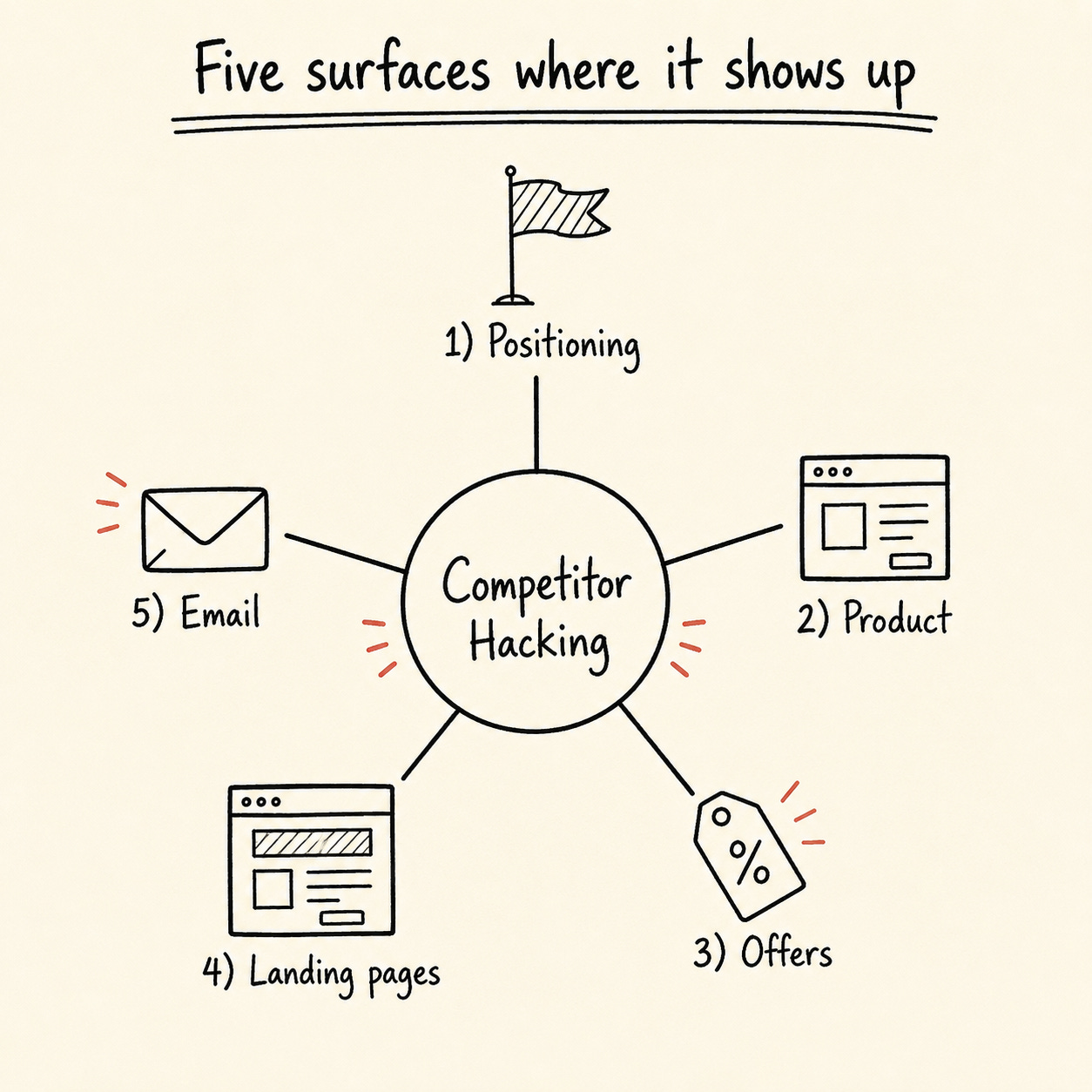
Once Competitor Hacking becomes the culture, it stops being a thing the team does occasionally. It becomes the way the team works.
The decks look sharper. The briefs sound more strategic. The campaigns may even look cleaner than before.
But the customer starts seeing less of herself in the work.
Here is where the damage shows up across the business.
Positioning starts answering competitor claims instead of customer doubts
Positioning loses force when marketers copy a rival’s enemy list.
A competitor says the problem is speed, so the business starts selling speed. A competitor says the problem is simplicity, so the business starts selling simplicity. A competitor says the problem is all-in-one convenience, so the business starts saying all-in-one too.
But the buyer may not be comparing those things.
April Dunford makes this point from the buyer’s side. In her essay on buyer-centric competitive positioning, the better question is not just “Who are our competitors?” It is “What would this customer use if our product did not exist?”
That list can include spreadsheets, agencies, a manual workaround, a junior hire, doing nothing, or a different habit entirely.
Customers do not buy inside an internal competitor chart. They buy inside their own life.
When a business copies the category’s positioning, it ends up arguing with rivals the customer was not even thinking about. The promise gets sharper against the wrong enemy. The sales page wins the wrong debate.
The buyer reads it and still feels unseen.
Product roadmaps chase public features instead of hidden friction
Products fall into the same trap.
A rival launches dark mode. A rival adds an AI assistant. A rival changes onboarding. A rival adds a community tab. The product team sees the launch, feels behind, and adds a version to the roadmap.
Sometimes that is the right move.
But a public competitor feature is not the same thing as hidden customer friction.
Customers leave products for small, plain reasons. The first setup confused them. The first win took too long. The product asked for too much before proving value. The support article assumed knowledge the user did not have. The dashboard looked simple to the business and confusing to the buyer.
Those reasons rarely appear on a competitor’s product page. They show up in support tickets, sales calls, onboarding drop-offs, cancellation notes, and confused replies.
Glossier’s Milky Jelly Cleanser gives a cleaner model. In January 2015, Emily Weiss asked Into the Gloss readers, “What’s your dream face wash?” Nearly 400 comments came back. Those comments helped shape the product brief: gentle, affordable, pH-balanced, makeup-removing, not oily, and not harsh.
The product gained shape from the people who would use it.
Offers start copying category mechanics instead of customer risk
Offers get copied because offers are easy to see.
A competitor adds a free trial. Another adds a 30-day guarantee. Another adds a bonus stack. Another adds annual pricing. Another adds a limited-time discount.
Soon the category has the same offer shape everywhere.
The mechanics are not bad by default. A good offer answers the customer’s risk. A copied offer answers the category’s habit.
A buyer may not need more bonuses. She may need proof that the first week will not overwhelm her.
A SaaS customer may not need a cheaper annual plan. He may need a setup path that makes switching feel less risky.
A skincare buyer may not need a discount. She may need trust that the product will not make the old problem worse.
A coaching buyer may not need a bigger guarantee. She may need to believe she will not be abandoned after the sale.
Competitor Hacking makes marketers ask, “What offer is working in the category?”
Customer understanding makes marketers ask, “What is this customer afraid will happen after she buys?”
Those two questions create different work.
Landing pages and ads teach buyers that every brand is the same
Marketers copy what they can see fastest.
They save competitor ads, screenshot hero sections, collect pricing tables, borrow proof blocks, swipe hooks from Meta Ad Library, and ask AI to turn the same pattern into ten versions.
The result can look good in isolation, which is the trap.
One copied landing page may look cleaner than the old one. One copied ad hook may perform better than a weak in-house idea. One copied checkout layout may reduce confusion for a week.
The first win makes the method feel smart.
But if every business in the category works from the same public pool, the customer starts seeing the same page with a different logo.
A 2024 Science Advances paper by Doshi and Hauser found a similar pattern with AI-assisted writing: individual work became more creative, but the total set of work became more similar.
Competitor copying creates the same category-level problem. One brand improves its page. Another improves its page from the same pool. Then another follows. Each brand may look slightly better alone. Together, the category becomes harder to tell apart.
The buyer does not need the theory. She just knows she has seen this page before.
Email becomes another place where buyers feel unseen
Email is not the whole article, but email is where the pattern becomes easy to spot.
A marketer opens a competitor email archive. Competitor screenshots shape the brief. The welcome flow borrows the same first message. The Black Friday sequence borrows the same discount rhythm. The winback borrows the same “we miss you” note.
But the buyer’s own words are already sitting somewhere inside the business.
Maybe those words are in reply text. Maybe they are in support tickets. Maybe they are in reviews. Maybe they are in sales-call notes. Maybe they are for cancellation reasons. Maybe they are in the comments under a product announcement.
The marketer reads the category instead.
The damage goes past email performance. A bad email result is only one symptom. The deeper problem is that the customer keeps receiving work built from everyone except her.
After enough of that, she stops believing the brand is talking to her at all.
That is when retention work gets harder. Not because the business stopped sending messages, but because the customer stopped feeling addressed by them.
There is a way to use Competitor Hacking without letting it run your business
Don’t get me wrong, competitor research has a place. It can help a business understand category norms, common proof formats, pricing ranges, and claims buyers may have already seen. The problem is not that marketers look at competitors. The problem is what gets crowded out when competitor research becomes the daily starting move.
Refocusing on the customer is not an overnight fix. Competitor Hacking did not become a culture in a single quarter, and it cannot be replaced in one either. It needs work at three levels: how the business thinks, how the team operates, and how an individual marketer spends their research time.
I have distilled this into a framework so businesses and their marketing teams can plug it into their existing way of working. The next section walks through it.
How to replace Competitor Hacking with customer research using the 10/20/30 Research Principle
Most marketers ask, “Should we do competitor research?”
The better question is, “How much room should competitor research take before it starts leading the work?”
That is what the 10/20/30 Research Principle answers.
Competitor research should never lead. At any stage of business or marketing, it should stay under a fixed ceiling: 10, 20, or 30 percent of total research time. The ceiling depends on what the business needs at that stage and what the customer needs from the business.
Here is the rule in one image.
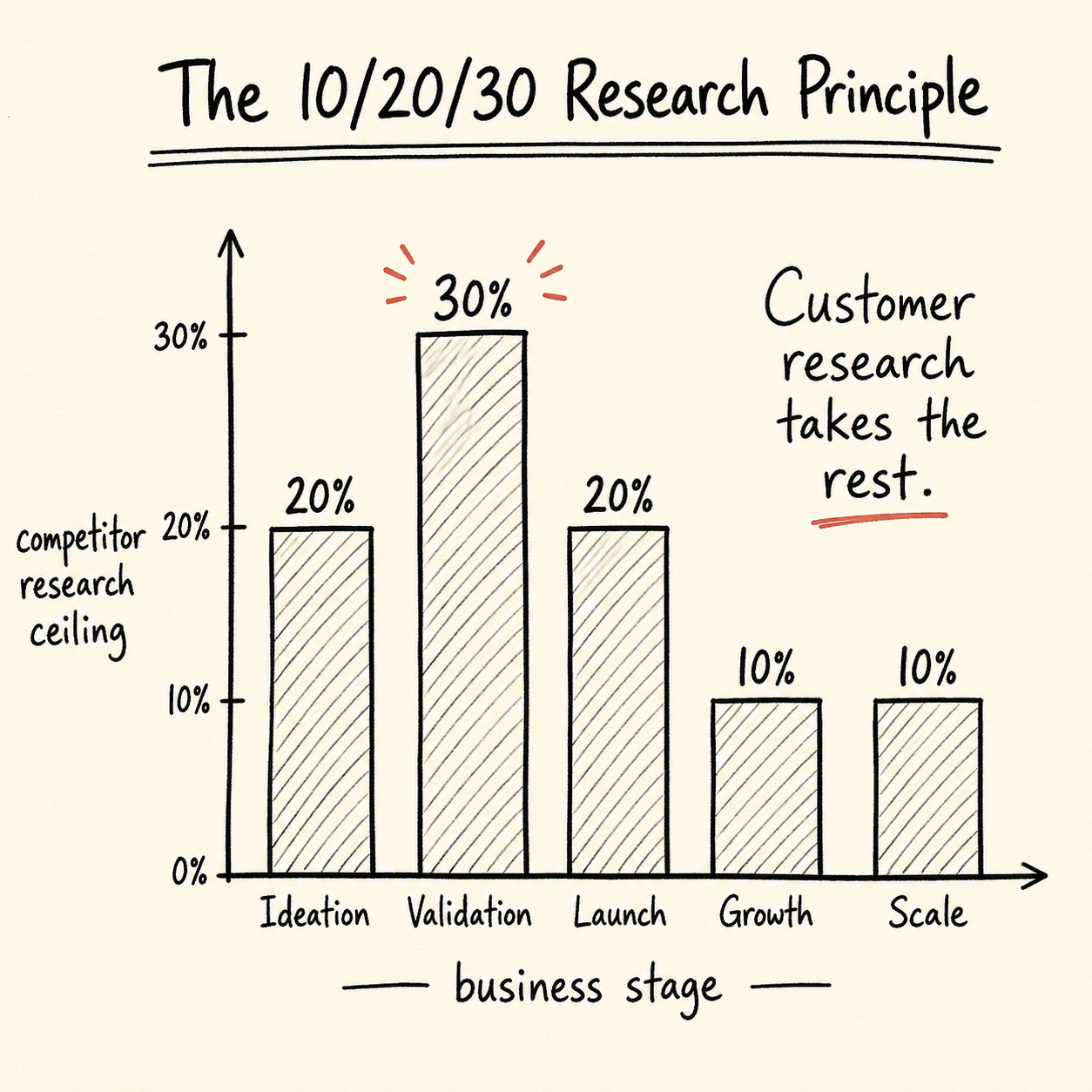
The deeper a business gets into real customer relationships, the less excuse it has to let competitor research lead.
But applying the principle is not a one-time tactic. Competitor Hacking is a culture, so the fix has to operate at three levels at the same time:
Philosophy is how the business thinks about where decisions come from.
Process is how the team captures customer truth so it is available when the work starts.
Practice is how an individual marketer spends their research time.
Skip any one of these and the principle breaks. The rest of this section walks through each level.
Philosophy: customer understanding leads, competitor research checks
The philosophy behind this framework is First Principles Thinking.
It means breaking a problem down to its most basic truths and building the solution upward, instead of copying what already exists.
In business, the first principle is not the competitor. It is the customer.
Who is this person? What is she trying to do? What hurts right now? What has she already tried? What does she fear will happen after she buys? What would she use if this product did not exist? What would make the next step feel worth taking?
Those questions come before the screenshot.
Competitor Hacking is reasoning by analogy. It says, “This looks like what others are doing, so it must be close to right.”
First Principles Thinking says, “Before we borrow the pattern, what must be true for this customer?”
The best positioning often comes from understanding the customer’s real alternative, not the category’s loudest rival. Sometimes the alternative is doing nothing. Sometimes it is a spreadsheet. Sometimes it is hiring someone. Sometimes it is denial.
Competitor research can show what others are saying. It cannot tell the business what must be true for its customer to care.
At the philosophy level, the rule is: customer understanding leads, competitor research checks.
Process: build a customer-understanding system before another swipe file
Most businesses have a system for competitor research by accident.
Screenshots go into folders. Ads go into Slack. Swipe files get shared. Competitor emails get forwarded. The material accumulates without anyone setting it up.
Customer understanding usually has no equivalent system.
Replies sit in inboxes. Support tickets stay inside support tools. Sales-call notes live in someone’s doc. Cancellation reasons get skimmed and forgotten. Reviews get used as testimonials, not research.
The process has five steps: capture, route, tag, review, act.
1. Capture the words customers already gave you. Read replies, reviews, support tickets, cancellation notes, refund reasons, sales calls, onboarding questions, community posts, and open-ended survey answers. Keep the rough words. “I bought it and never opened it again” is stronger than “activation friction.”
2. Route customer truth somewhere people actually see it. A Slack channel. A weekly doc. A Notion database. The tool does not matter as much as the habit. One of the most useful systems I worked with was simple: two open-ended questions added to a welcome email, with replies flowing into a dedicated Slack channel. That one channel gave me subject lines, CTAs, newsletter angles, and sharper offers because the customer language stayed alive.
3. Tag the words by what they reveal. Not by content category. By what they expose. Fear. Desired outcome. Confusion. Objection. First-win problem. Trust problem. Discount waiting. Failed expectation. Referral language. Those groups become the working map.
4. Review it before the brief starts. Customer understanding should not begin when a campaign is due tomorrow. Set a rhythm before the deadline arrives. Weekly reply review. Monthly churn review. Support-ticket themes. Sales-call language. The customer should already be in the room before the brief starts.
5. Act on the pattern. Collecting customer language is not the work. Using it is the work. Improve a subject line. Rewrite an offer. Change onboarding. Fix the first week after purchase. If customer understanding does not change the work, the process is just another folder.
Practice: apply the 10/20/30 ceiling by business stage
Practice is where the principle becomes simple. Look at the business stage. Decide how much research time exists. Cap competitor research before it takes over.
Ideation — 20 percent max. The business is trying to understand the problem and shape the idea. Competitor research can show what already exists, but if it takes over, the business starts building a version of someone else’s solution before fully understanding the problem.
Validation — 30 percent max. This is the only stage where competitor research can go as high as 30 percent. The business needs to check alternatives, price signals, category expectations, and what customers may already compare against. But validation is not proving competitors exist. It is proving real customer demand. Customers still lead.
Launch — 20 percent max. The business needs clear messaging, a strong offer, and a reason for the audience to pay attention now. Competitor research can show overused claims, common proof formats, and offer mechanics buyers may have already seen. But the launch should be built from customer language, customer fear, and the real reason someone would buy.
Growth — 10 percent max. The business has customers now. That changes everything. Replies, reviews, usage data, support tickets, cancellation notes, sales calls, purchase behavior, and repeat patterns are more useful than another competitor teardown.
Scale — 10 percent max. The business needs repeatable systems, stronger retention, and more efficient growth. Copying at scale spreads sameness faster. A copied positioning line becomes a campaign system. A copied offer becomes a promotional calendar. A copied lifecycle flow becomes the default customer experience. At Scale, competitor research should be a small category check, not a decision engine.
How the three levels compliment each other
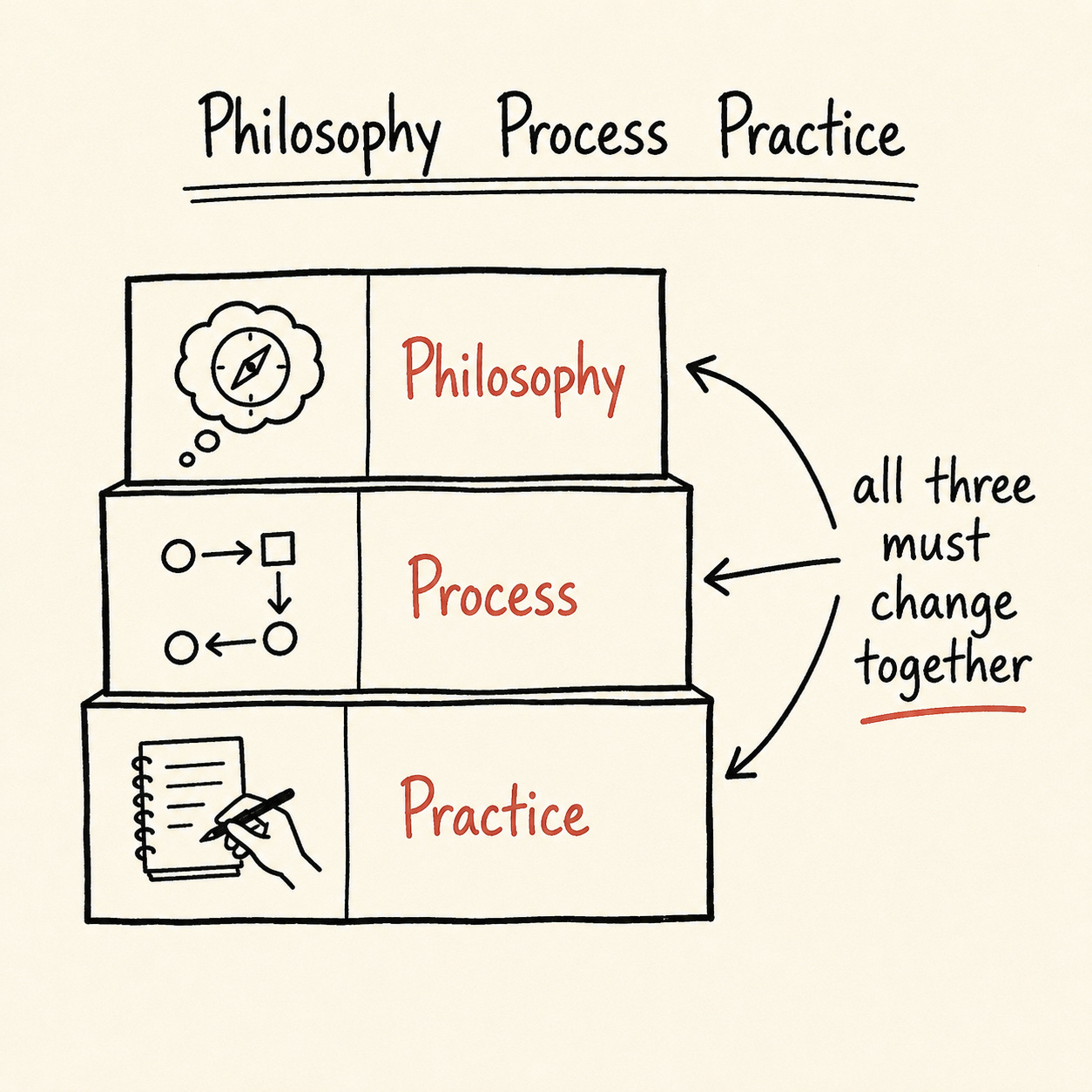
The 10/20/30 Research Principle works only when all three levels work together.
Philosophy without process becomes a nice belief. A business can say it believes in First Principles Thinking, but if customer language has no place to live, marketers will go back to screenshots the moment a deadline hits.
Process without practice becomes a library nobody uses. A business can collect replies, reviews, tickets, and survey answers, but if marketers still spend most of their research time on competitors, customer truth stays in the background.
Practice without philosophy becomes a rule people break under pressure. A marketer can try to follow the 10/20/30 ceiling, but if the business still treats competitor examples as the safest evidence, the old habit comes back.
That is why the framework needs all three levels.
First Principles Thinking tells the business where decisions should come from. The customer-understanding process keeps customer truth available. The 10/20/30 ceiling stops competitor research from taking more space than it deserves.
Highlights of how the 10/20/30 principle impacted my past work
Now, I did not sit down to find all previous case studies for this part. I’ll only mention what I can remember off the top of my head to show how much the 10/20/30 principle impacted my marketing approach for just one client:
Revenue per lead more than doubled at a SaaS business. Went from $13 to $27 across the engagement. The audience did not grow more than usual. The business got better at creating value from the audience it already had.
A single webinar campaign brought back $1.1M from attendees the business had written off as lost. The hooks, objection handling, and follow-up came from replies and tickets the team had not connected to a campaign before. The audience was not lost. It was misread.
Subject lines, CTAs, and newsletter angles stopped feeling like guesses. Customer language from welcome-email replies fed every campaign. The work got sharper because the audience was already in the room before the brief started.
Briefs stopped opening with screenshots. Customer truth became the first input. Competitor research stayed in the work, but only as a check, never as the source. That single shift changed how every campaign got built.
The standard for judging the work got better. “Does this sound like the customer’s problem?” replaced “Does this look like what the category is doing?” That one switch made it harder to hide behind familiar work.
Why you should avoid competitor hacking now more than ever
Customer alienation has always been the cost businesses notice last.
But the gap between the moment a customer goes quiet and the moment a business notices has never been wider than it is right now.
AI made content cheap. It made copying easier. It made every category louder and more crowded than it has ever been. A new landing page can be cloned in an afternoon. A welcome flow can be lifted from any inbox. An ad hook can be turned into ten versions before the original brief is finished.
The result is a category-level sameness no business has ever had to compete against before. Buyers are seeing the same page, the same hook, the same offer, and the same “we miss you” email from every brand in their inbox. They cannot tell brands apart, and they have stopped trying.
The faster the category moves, the louder the noise gets, the harder it becomes for a brand to stay memorable. Competitor Hacking accelerates the noise. It does not protect the brand from it.
That is why the moment to slow down is now.
While most marketing teams are chasing AI shortcuts, swipe files, and faster competitor teardowns, the businesses that go back to basics (reading their customers, understanding their problems, building from real evidence) are the ones who will still be remembered six months from now.
A cook who copies his neighbors does not survive a busy street. A business that copies its competitors does not survive a crowded category.
The cook never asked his regulars why they stopped coming. He just kept looking across the street.
Many businesses are doing the same thing right now.
They know the competitor’s launch, discount, homepage, onboarding, email, and feature list.
They do not know what their own customer was trying to tell them last week.
A retention number fits neatly on a slide. A bored customer does not. A renewal rate can be charted. A customer who no longer believes the brand has anything clear to say is harder to chart. A referral drop can be measured. The moment a customer stops having a sentence to describe the brand is harder to find.
The business often notices late.
So the question you need to ask yourself is this:
What would you do to make sure your customers know you are the one to turn to?
Make them feel seen and heard.
Or pay attention to how your competitors are trying to get their attention?
Your answer will decide your marketing approach going forward.
Follow me on LinkedIn and Substack for more of this kind of writing.
Valuable Read!